The Capitol's Granite Came from Marble Falls. The Quarry Is Still There.
The stone that built Texas's most recognizable building was pulled from a Hill Country hillside by men who had no choice in the matter.
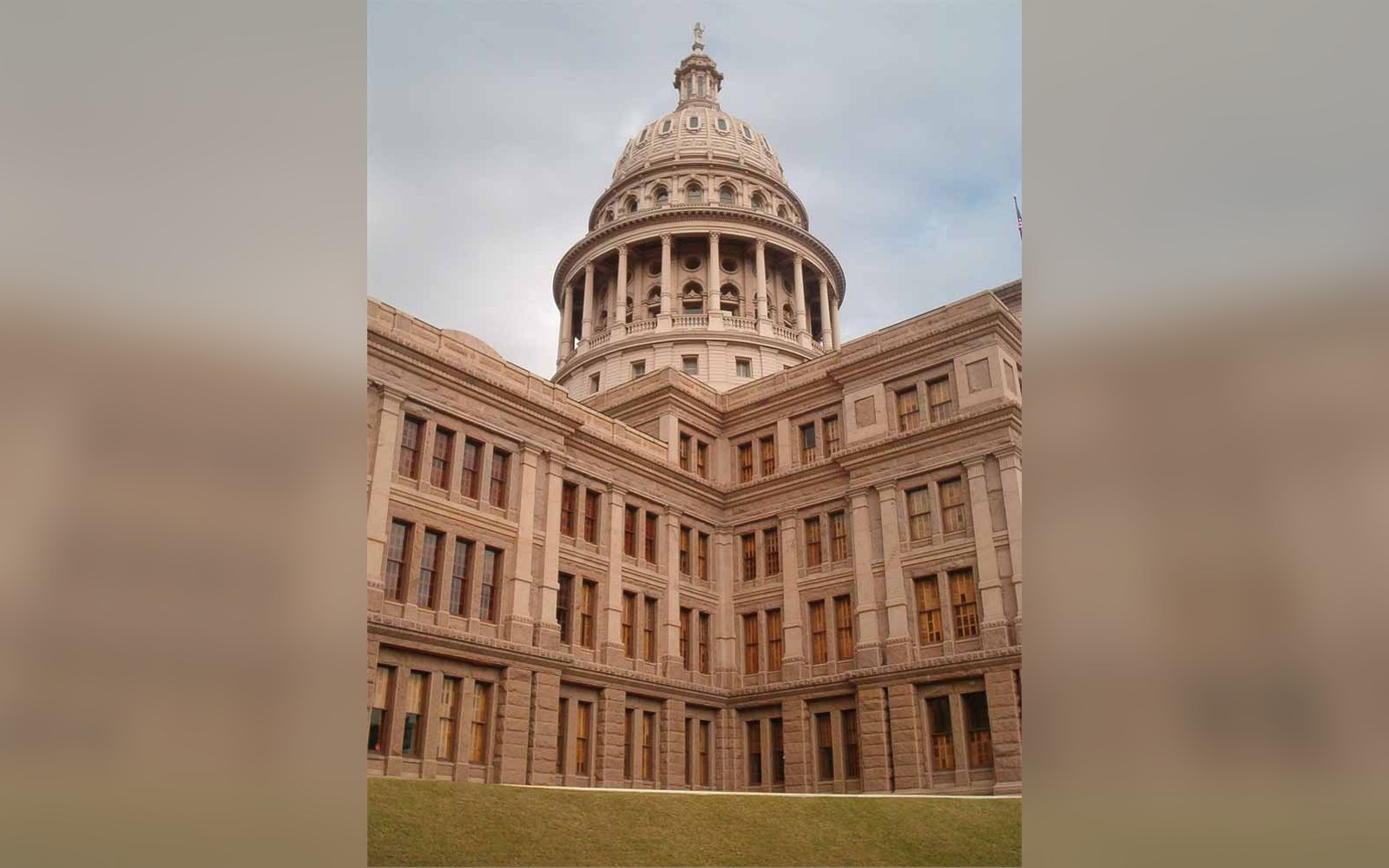
Sunset Red granite, quarried at Marble Falls and hauled in by rail.
Photo: TexasCapitolExterior · Wikimedia Commons
A Hill Country Stone, a State Contract
The Texas State Capitol, completed in 1888, is built from a granite that does not exist anywhere else under the same commercial name. The Texas State Preservation Board, which maintains the building's official record, identifies the material as Sunset Red granite — a coarse-grained, iron-bearing variety quarried from Marble Falls, roughly fifty miles northwest of Austin in Burnet County. Its color shifts across the day, moving from pale pink in flat morning light toward a deeper rose under direct afternoon sun, which is why the building reads differently at noon than it does at dusk.
The Capitol dome rises 309 feet above the ground — taller than the United States Capitol in Washington by a margin that the State Preservation Board documents at seven feet, a fact Texans have been repeating for well over a century. The structure covers three acres of ground and contains approximately 392,000 square feet of floor space across its multiple levels. Architect Elijah Myers of Detroit won the original design competition; the firm Ryon & Dodson managed the construction contract on the ground.
Cast-iron lattice, bought secondhand in 1895 and still carrying light.
Photo: AXP Photography / Pexels
Quarried by Convicts
The granite did not arrive at the construction site through ordinary commerce. Texas had a granite supply problem: the state was nearly broke after Reconstruction, and the Capitol was supposed to be funded through a land grant — three million acres of Panhandle land traded to the contractor Matthias Schnell, and later the syndicate that became the Capitol Freehold Land and Investment Company, in exchange for construction. Cash for materials was scarce.
When the Marble Falls granite was identified as suitable — and geologically accessible along what is now the Burnet County quarry site — the state arranged for the labor through its prison system. Convict laborers from the Texas State Penitentiary were transported to Marble Falls to work the quarry face, cutting and loading granite under conditions that Texas State Library and Archives Commission records describe in the documentary record of the construction period. The arrangement was legal under the convict-lease system then standard across the post-Reconstruction South. It was also contested: Scottish stonemasons brought in for finishing work went on strike in 1886, objecting to working alongside convict labor. The state responded by importing replacement workers from Germany.
That friction is part of the building's material record, not a footnote to it. The Capitol was not simply constructed; it was assembled through a specific set of economic and legal instruments that a post-Civil War Texas state government had available to it.
Key dimensions
| Height of Capitol dome | 309 feet above ground level |
|---|---|
| Margin over U.S. Capitol dome | 7 feet (State Preservation Board) |
| Original building footprint | approximately 3 acres |
| Original floor area | approximately 392,000 square feet |
| 1993 underground extension | approximately 667,000 square feet added |
The Underground Extension
The 1888 structure has since been enlarged in the one direction that did not disturb its silhouette. In 1993, after more than a decade of planning, the state completed the Capitol Extension — a four-story underground annex beneath the Capitol's north grounds, connected to the original building by tunnels. The extension added roughly 667,000 square feet of office and support space, more than doubling the Capitol complex's total usable area without altering the above-grade elevation. The exterior of the north grounds was restored to lawn and oak plantings above it.
The extension's construction required one of the largest urban excavations in Texas history at the time. To maintain visual and material continuity, the above-grade portions of the extension — the low pavilions at the north entry — were faced in the same Sunset Red granite drawn from the Marble Falls quarry, which had remained workable and accessible.
The Quarry Today
The quarry at Marble Falls — on land adjacent to what is now a developed area of Burnet County — still exists as a physical feature in the landscape. Commercial granite quarrying has continued in the broader region, and the Marble Falls area remains associated with the Texas granite industry. The specific faces worked during the 1880s construction campaign are not in active production, but the geology that produced Sunset Red has not changed: the same Llano Uplift formation, one of the oldest exposed rock surfaces in Texas, runs beneath Burnet and Llano counties and yields material that, under the right cut and light, still matches what the 1888 contractor loaded onto flatcars and sent down to Austin.
Towers that broke ground in the boom finished into a softer leasing market.
Photo: Austin Downtown 2018 · Wikimedia Commons
The building is the most documented structure in state government records. It is also, in the most literal sense, a piece of the Hill Country, quarried by incarcerated men, dropped into the capital's center, and still standing.